Monday, April 27, 2009

Fewer Mistakes and Less Misunderstanding: A Number of Problems that Need a Large Amount of Attention


In the world of nouns there exist count nouns and mass nouns; in Wal-Mart, only mass nouns exist. I guess the that the members of Wal-Mart corporate have lost sight of their products as individual items, or perhaps they, along with many other big businesses, are simply guilty of large scale grammatical infraction. The grammar violation I am referring to is, of course, the “10 items or less” check out aisle. This seems to have become the standard label used to attract shoppers who plan on buying only a few items. I find it hard to believe that such a blatant and consistent mistake could be made on such a large scale.

But what exactly makes my local grocery store and Wal-Mart incorrect? And what should the Aisle sign read? Well, it’s like I said earlier; Wal-Mart apparently does not have a great hold on the concept of mass nouns and count nouns. A count noun is anything that is discrete or can be counted, they always use fewer when described as such.

Example: fish, beans, cars, jokes, countries, ITEMS, etc.

“Frank caught fewer fish than Joaquin today.”

A mass noun is something that cannot be counted in individual units and that you don’t make plural. Mass nouns are described with less

Example: water, clutter, traffic, communication, noise, trust etc.

“There is always less traffic on Tuesday.”

In some cases, certain words can be tricky. Water is one of the examples that I used for mass nouns, and yes, it is correct to say, “The plants need less water,” but what if you mean to refer to cups, or bottles of water? Well, it would then be incorrect to say, “The plant needs less cups of water” or “the plant needs less waters.” I said earlier that mass nouns are never plural, and I was telling the truth. While the word “waters” is plural it has been made into a measurable unit and has been transformed into a count noun instead of a mass noun. Other notorious examples are “money” and “time,” which are in fact mass nouns, except when defined as units or specific quantities.

“Tom had took less time to finish the exam than Gordon.” OR “Tom took fewer hours to finish the exam than Gordon.”

“Reuben had less money after visiting the casino.” OR “Reuben had fewer dollars after visiting the casino.”

With these basic rules in mind, I hope you have figured out by now that all of these speedy checkout aisles should read, “10 items or fewer.”

I do not make the argument that all of these aisles should read “10 items or fewer,” just that they should not read “10 items or less.” I see no problem with signs reading “up to ten items” or “As many as 10 items.” These alternative signs are perhaps wordier, but would in fact help Wal-Mart have fewer grammatical errors.

Count and mass nouns are not just an issue for “10 items or fewer” aisle, the media are a culprit as well. All too often, news reporters and radio hosts fail to abide by the laws of count and mass nouns. This time the major problem is not “fewer versus less” but “amount versus number.”

Just as a count noun is described with “fewer,” it is also described with the word “number” when talking about its quantity.

“ The number of car crashes this year was alarming.”

“ Francis assumed a number of people would walk by.”

The word “amount” is used in the same way for mass nouns, but since mass nouns have no quantity, “amount” is used to describe their extent.

“The amount of confusion was significant.”

“Jerome knew that the amount of noise was enough to get him in trouble.”

So, with this new noun issue in mind, I hope you too will pick up on the frequent errors in news. The next time a news anchor says, “The amount of deaths was shocking,” or “no amount of words can describe this tragedy,” you will know that he is grammatically incorrect.

I hope that I have made the issue at hand clear by now- to help you gage your amount of understanding, here is a link to a count and mass noun quiz I hope you will enjoy
Many people have chosen to join the fight in favor of correct mass and count noun use, Trader Joes is one example of a business that recognizes the correctness of “10 items or fewer” aisles.
I hope you too can help to stop “less” and “amount” from invading the territory of count nouns before they become the norm. To see what others involved in the fight have to say and for more information, check out some of my sources.

Grammar Glamour

I wish I may, I wish I might

Click here to download this podcast!

Hello and welcome to Grammar Glamour. Today we’ll be discussing the differences between may and might. I may go to the park. I might go to the park. Do they mean the same thing? Are these two words interchangeable or are there significant differences between them? I’ll be addressing these issues during this Grammar Glamour podcast.

The differences are subtle, which is why people tend to have problems differentiating between the two. While both words concern themselves with possibility, something that may happen is more likely than something that might happen.

For example, you would say “I may go to the park if my friends go,” but, “I might go to the park if you pay me.” The second sentence has a sarcastic tone to it, which means it is unlikely that you actually intend to go to the park.

Something is more promising if it may happen. If you were to say, “I may get a promotion” it is more likely that you will get a promotion than if you were to say, “I might get a promotion.”

People often get confused with may because it can signify not only possibility, but also permission. For this reason, it makes more sense to say “We might not go to the park later” because saying, “We may not go to the park later” could sound like you are not allowed to go to the park.

It is also important to know that both may and might are modals. There is some argument in the grammar world about whether or not modals have tenses. Some say that might is the past tense of may. Others argue that modals have no tense at all. There is still another argument that, while both can be used in the present and past tense, if there is another verb in the sentence that is in the past tense, then you should only use might. For example, you could say “She may have failed the test” or “She might have failed the test,” depending on the degree of possibility. But, regardless of the possibility, you would say, “She thought she might have failed the test.” This is because “thought” is in the past tense.

There is another case when may and might have very different meanings. “The medicine may have healed her” means that she was healed and it could be because of the medicine. “The medicine might have healed her,” means that she was not healed but could have been if medicine had been used.

That’s all I have for you today! Thank you for listening to Grammar Glamour!

By: Chelsea Moir

Sources:

Grammar Girl website

http://grammar.quickanddirtytips.com/may-might.aspx

O’Connor, Patricia T. Woe Is I. Riverhead Books, NY. 1996. pg. 61

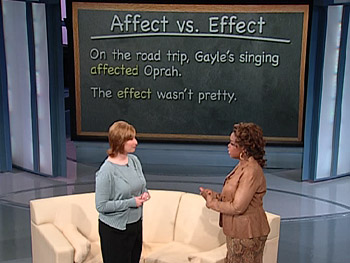
Affect vs. Effect

One of my biggest pet peeves when it comes to the English language is writers misusing words in their work, by using the wrong homophone in a sentence. There are dozens of these homophonic pairs, and writers are often confused as to which one should be used in any given context. A cheating husband, for instance, is not having a “discrete affair;” he is (hopefully) having a discreet one. “Its” and “it’s” are constantly interchanged even in street signs and publicly displayed ads, and let’s not even get started on the confusion among “their,” “there,” and “they’re.” But of all these examples, the one that I find the most irritating is the mix-up between “affect” and “effect”.


Though there is only a one-letter difference between these two homophones, there are huge differences in what they mean, and in what context each belongs. Affect and effect are completely different parts of speech: Affect is generally a verb, while effect is nearly always a noun. The word “affect” means “to have an effect on,” or “to influence.” Meanwhile, “effect” is a word which means “a result.” In examples:


The humidity affected my hair by making it frizzier.

The humidity had a frizzing effect on my hair.


This is fairly easy to keep straight; it seems the main reason people make mistakes when using them is because they are unsure whether the noun starts with an A or an E. Grammar Girl has a simple mnemonic for this, as illustrated in the cartoon below.

As we can see, “arrow,” “aardvark,” and “affect” all start with an A, while “eye-popping” and “effect” start with an E. In most cases, this will help keep affect and effect straight in writers’ minds.


However, there are a few rare instances in which “affect” is used as a noun, and “effect” becomes a verb.

- Affect is a noun generally in the context of a psychological study, where a psychologist will note that a patient is displaying a certain behavior. An example: The patient was displaying a depressed affect. According to Grammar Girl, psychologists like to use this word to describe their patients’ emotions because it is impossible to tell what someone is really feeling; psychologists can only see how they appear to feel.

- When used as a verb, effect means “to bring about,” or “to accomplish.” Example: Obama hopes to effect change in America.


However, these are quite rare exceptions that are only really relevant for maybe five percent of the times either word is used. For the most part, affect should be used as a verb, and effect should be a noun. With practice, and the help of the mnemonic, it should be easy for writers to finally get the difference between them down.


Source:
Grammar Girl

That's What S/he Said!

Along with the adaptation of vocabulary and the growth of the English language, comes the question as to whether or not strict grammar rules also can be adjusted with new trends. In a country where speakers must be politically correct at all times, including gender and racial bias, it is important to be aware of how one uses pronouns, both in conversation and in text.

In my opinion, the most common grammatical error made is the use of the pronoun ”they” or “their” as a singular pronoun, rather than a plural pronoun. While I’ll admit, I too frequently use “they” as a singular pronoun in conversation, I am often tempted to write “they” as a singular pronoun in papers and other written text as well.

Picture yourself at a rock concert with thousands of people on their feet cheering and singing along. The drums fade out and the lead singer throws his hands into the air, screaming into the microphone, “everybody clap his or her hands.” What is the chance of that happening? While I don’t have the statistical data on that phrase being said at a rock concert, I would have to bet on the fact that it has probably never been used. You may ask, “but why? After all, it is correct grammar.” Yes, while “his or her hands” is grammatically correct, in certain contexts, “he or she” can be inappropriate.

While others have acknowledged that using a singular pronoun is the correct pronoun to use and therefore should only be used, many problems arise when using it in speech and in text.

Solutions throughout the years:

1. Use only “she” or “he” as a pronoun for gender-neutral terms and be consistent with which pronoun you use. However, in modern times that becomes very problematic because of sexist and gender-biased writing.
2. Alternate using “he” or “she,” but in my opinion (along with many others), alternating pronouns becomes confusing to both the reader and the writer.
3. Use a genderless alternative such as “hiser,” “ze,” or “hir,” an idea introduced in the 1800s.
4. Make a symbol out of “he or she,” such as “s/he.” In my opinion, this appears to be more informal than using “they” or choosing “he” or “she.”

Solutions according to public figures:
1. Hilary Clinton constantly used “she“ as a singular pronoun, forcing listeners to open up to the idea of “she” as a main pronoun in speeches rather than “he.”
2. Shakespeare has been noted to use “he” as a generic singular pronoun; however in Romeo and Juliet, Shakespeare uses “they” as a generic singular pronoun.
3. Mark Twain and Jane Austin both also used “they” as a generic singular pronoun.
4. Rogers attempted to invent his own pronouns: e, es, and em. Unfortunately, all records of invented pronouns have not been easily adapted into the English language.
5. President Obama has even used “their” as a singular generic pronoun at times and has not been picked apart by the media in the same ways that George W. Bush had been scrutinized for grammatical errors. In speeches, Obama has no problem with using “their” as a singular pronoun, copying the speaking language of a vast majority of Americans.
6. Facebook.com has recently decided that “they” is not a singular pronoun and has forced its users to pick a gender so that the website is not forced to say “he or she.” One argument that facebook.com brought up was that “themself” is not a real word and therefore, they should not be used as a singular pronoun.
7. College students tend to use “he or she” in papers and stay away from using “they.” In my personal experience I tend to stay away from sentences that require a generic singular pronoun and solve the problem by rearranging the sentence.

As a writer and student of English, I find that “he or she,” “they,” and just using “he” or “she,” all have their place within the English lexicon. Academically, there is no reason as to why “her or she” shouldn’t be used. In my opinion, it is the most formal answer and makes perfectly clear what the writer is trying to express. In speech (the formality of the speech can be up for debate) I do not see a problem with using “they” or “their” as a singular pronoun. It is most commonly done and is not even registered as an error to most when in the middle of dialogue.

In official documents (such as the Constitution) I think it is clear that even though “he” is used the meaning is generic. Although this would be less common in my personal writing, I do believe that there is a certain time and place where using only “he” or “she” is acceptable; however, I disagree with the interchanging of the two throughout one piece of writing.

Overall, the question of generic personal pronouns will never be completely solved, but I do think it is important to learn when the use of informal generic pronoun use is acceptable. With the changing of times, comes the changing of language, and even generic pronouns need to learn to adapt to the new speech of society.
~Marissa Messiano

Works Used
Vosgerchian, Jessica. "Everybody does it, don't they?" Www.michigandaily.com
6 Jan. 2009. University of Michigan. 17 Apr. 2009 .

"The Most Annoying Thing Ever"

While I find it hard to believe that something could in fact be “the most annoying thing ever” my best friend swears that my tendency to end sentences in prepositions has taken that title. She has a tendency to be a bit dramatic, but once she pointed out how often I do it, I also became annoyed. She tells me it is at its worst when we are leaving the apartment to go somewhere and I am searching for the pieces of my life, asking questions such as; “Where’s my purse at? Or what are we waiting for?” These are the types of things I get yelled at by my friends (and my mother) all the time and until this assignment forced me to dig deeper into the official rule, I honestly assumed I was wrong.

Well guess what…I am not.

Before I get to brag though, I should set down the framework for understanding what a preposition is. According to the dictionary a preposition is: “any member of a class of words found in many languages that are used before nouns, pronouns, or other substantives to form phrases functioning as modifiers of verbs, nouns, or adjectives, and that typically express a spatial, temporal, or other relationship, as in, on, by, to, since.” Basically a preposition shows the relationship between ideas in a sentence.

So where does the idea that it is grammatically wrong to end a sentence in one of these darling little add-ons come from? The answer to that question lies in the roots of our language; Latin, which we all know is not the most up to date language in the world, considering almost no one speaks it anymore. While there are many valid grammar rules that have their roots in this beloved language, this is simply not one of them anymore. Grammarians agree across the board; ending a sentence in a preposition is a-ok.

The debate comes from the method by which people try and fix a sentence that ends in a preposition.

When the sentence, That's the writer I must talk to becomes That’s the writer to whom I must talk it sounds instantly more formal and less like how people actually speak. This is what happens when we try and put this outdated rule into action; our writing becomes unnecessarily awkward sounding, and incredibly clumsy in organization. Usually when this rule is followed in speech or in writing sentences become cluttered with too many “to which” or “to whom” phrases and it actually makes more sense to just end with the preposition. Winston Churchill made this point famous after a reporter mocked him for ending a sentence in a preposition at a press conference; his reply to the reporter? "This is something up with which I shall not put!" Clearly making fun of the reporter’s insistence on being grammatically correct even when the corrected sentence sounds terribly awkward.

The standard rule for when a sentence can end in a preposition is somewhere along the lines of; in the case where the pronoun is that, which cannot be preceded by a preposition, or if the pronoun is omitted altogether, then the preposition must occur at the end at the end of the sentence.

So all these years that friends, teachers and parents have tried to convince me that I am wrong for the way I speak, I was right. I used to spend so much time and energy trying to correct myself when I spoke, making sure that I wouldn’t sound like some uneducated, Midwestern hick. There was not any need though; grammarians have convinced me that there is nothing to change. A sentence in the English language can end in a preposition and no one will die, the world won’t end, and the sun will keep shining.


To all my friends out there: Want proof that I am correct? Check out my sources
The Language Log:

Everything2:


Grammar Girl:

Grammar Tips:

Dictionary

Writing These Posts, the Blog Looked Much Fuller


Although in languages such as German (and, less recently, Latin) word order doesn't change the meaning of sentences, it is of the utmost importance in English. Modifiers that are moved to the wrong place in a sentence can totally change the meaning of the message, occasionally in ways that the writer may never have thought of.

Each of the four examples surrounding this post (I couldn't get them arranged the way I wanted) illustrates an example of a misplaced modifier. The first (upper left corner, then go clockwise) reads "After eating too much chocolate, the scale told me I had gained ten pounds." In this case, the problem is with the placement of the adjective phrase. As it is, it looks like it is modifying the scale, which is impossible. The scale didn't eat too much chocolate, you did.
The second reads "I ordered a pizza for my friend, covered in pepperoni." While this one is easy to understand, the word order can confuse people into thinking that you first buried your friend in a mound of pepperoni and then proceeded to order him a pizza. This, while awesome, is (hopefully) not the case.
The third one says "Rowing across the lake, the moon occasionally disappeared behind the clouds. The problem here is obvious - the moon is not rowing, you are. Well...maybe your friend is. It's pretty dark out there. Maybe you're afraid of the dark. Especially if the moon is disappearing behind the clouds. That makes it even darker.
The last one says "Pickled in spiced vinegar, the host thought the peaches would go well with the meat." Again, a misplaced modifier. This one presents a variety of problems. First off, the host is clearly contaminating the vinegar. Gross. Second, it's completely rude to vegetate in an acidic liquid while simultaneously entertaining guests. Third, the host probably isn't pickling, the peaches are.

So now you know the danger of misplacing your modifiers. Look for it in articles and things, since it is a pretty common and (especially now that you're informed) easy to spot.

"This is He/She" versus "This is Him/Her"

As long as I can remember, my mother has ingrained it into my head never to use “This is her” when answering the phone or being questioned about my identity. Therefore, whenever I hear someone use the incorrect usage, I want to immediately correct them. This grammatical problem is most often heard when answering the telephone. I believe that it is very important for people to know the correct form so that they are saved embarrassment when talking to a possible employer or other important authority figure. Especially regarding employers, first impressions mean everything and a simple slip up like this could hinder someone’s chances of getting a particular job, especially in the current economy with few job opportunities. Even the simplest of things can have large consequences. I have spoken with employers before who become peeved with grammar slip-ups because these mistakes seem unprofessional. Therefore, I feel the need to post this so that none of us makes this mistake.
As we have learned, pronouns take the place of the noun and there are three different cases of pronouns: nominative, possessive, and objective (1). This particular example refers to pronouns in the nominative case. The nominative case is used for the pronouns I, he, she, we, they, and who (1). These pronouns are used if they re-name the subject (1). The easiest way to understand which form to use is by switching the sentence around, like we discussed in class. For instance, if a sentence says, “The only one invited was she”, it can be flipped around to read, “She was the only one invited.” (1) This is the correct form instead of saying “Her was the only one invited.” Without knowing any grammar rules, it is easy to hear that the statement does not sound correct. Therefore, if you reverse “This is she” it would read, “She is this”. That sounds much better than “Her is this”. In order to avoid using the incorrect pronoun, many people simply say “Speaking”, but it is valuable to know which pronoun to use.
After I heard my roommate use the incorrect form the other day, I went to be annoying and correct her, and she asked me why that was the correct form. I couldn’t adequately explain to her the correct reason other than that my mom was an English teacher so she must know what she is talking about. Now, I know for sure what the correct usage is, and can explain to people why it is incorrect. Hopefully, now, you can too!


Works Cited:

Ellsworth, Blanche and Higgins, John A. English Simplified. New York: Pearson
Education Inc, 2007.

Caroline Adams

Sunday, April 26, 2009

e-Communication and Academia: Can't They Just Get Along?

A Response to  “Informal Style of Electronic Messages Is Showing Up in Schoolwork, Study Finds” by Tamar Lewin

   A recent study led by the Pew Internet & American Life Project revealed a growing instance of students allowing their Internet and text messaging slang to leak into schoolwork. This study worked with 700 nationally representative children ages 12 to 17 and their parents. Of this number, two-thirds admitted that their e-communication slang often appeared within written assignments or school. One-fourth of the 700 claimed to have used emoticons in schoolwork, and one-third used test shortcuts such as LOL (Lewin). These numbers show an alarming influx of ungrammatical communication being used within school, influenced by students’ extensive use of e-mail, texts, and social network sites. However, is this acceptable? Should there be a fine line between social language and the language of academia?

            Lewin’s article cites an interesting opinion on the matter, one of Richard Sterling, emeritus executive of the National Writing Project. He believes that this growing phenomenon should be looked at in a positive light, for it allows teachers the opportunity to explain the importance of context in writing (Lewin). They could relate to students when and where such slang is appropriate and useful, and where it is not. Sterling also goes further to predict that the nonstandard phrases and grammatical shortcuts that are being used by many students may very well become acceptable. He believes that starting a sentence with an upper-case letter is unnecessary, and that one day this standard will be dropped (Lewin). After all, isn’t the point of communication to be able to express thoughts as easily and conveniently as possible? Sterling is not worried about the changes that may come in the world of the grammatically correct—after all, the English language has always been evolving.

            The study conducted also touched on a really interesting point—most students do not think of their e-communication-style writing as “real writing” (Lewin). So is the use of Internet slang in schoolwork an instance of habit, disregard for grammatical standards, or pure laziness? Perhaps it is a mixture of all three. When students observe a growing presence of convenience-writing, which they are a part of, filtering into places of high grammatical standards, why would they feel the need to stop? Such forms of communication are widely used and understood, and also take less time to get across. However, I believe that the world of academia should have high standards, and stick to them. Academics are a form of higher-level thinking and thus must therefore incorporate standards of a similar degree regarding writing. Perhaps certain rules can be amended in order to change with the times, but not to the extent that it would butcher the true essence of the English Language--especially when being used professionally. Without strict standards, how would one be evaluated on their writing skills? I believe that e-communication shortcuts and phrases should be reserved for the Internet and cellphones. As Sterling had said, students must learn to be able to evaluate where and when certain writing styles are acceptable, and for now, that means no to emoticons in an English paper. 

Meet the Em Dash: —!

[by Kelsey Miller]
While the name might sound reminiscent of a track event (or possibly a nickname for a hyperactive girl named Emily), the em dash is a punctuation mark and is that long-looking hyphen included in the title. Oooo! Ahhhh! The em dash resembles the hyphen(-), but is longer both in actual length(—) and the length of pause it adds to a sentence; therefore, the em dash is way cooler. The name originates from type spacing, as this dash is the width of the typed letter m. Also of interest, recluse Emily Dickinson’s poetry suggests that the em dash might be her favorite punctuation mark. Take a moment to ponder the link between the name “Emily” and “em dash.” Hmm…

For correct usage of the em dash, first consider the hierarchy of punctuation breaks. The first and least restrictive to the flow of the sentence is the comma. Next is the em dash, allowing for more of a stop than the comma. Third is the parenthesis, which pulls away from the sentence more than the first two. The em dash also implies less subordination than the parenthesis, allowing that parenthetical phrase to be more included in the sentence. Maybe the parenthesis needs to learn how to play nice. Last in the hierarchy come the brackets, which allow for a parenthetical within a parenthetical.

Keep in mind that the em dash should be used sparingly in formal writing. Usage in a blog like this, emails, and casual writing (personal essays, or writing assignments casual enough not to need works cited, etc). Em dashes could be used in correctly punctuated text messages too, but good luck finding a cell phone that recognizes two hyphens as an em dash. The first use of the em dash is denoting a parenthetical phrase, but an em dash (or parenthesis) is necessary when the parenthetical phrase already includes a comma. For example:
The students will arrive—by bus, not plane—Saturday night.
Otherwise, use an em dash to add emphasis, an interruption, or signal an abrupt change. Compare the two sentences:
I pay the bills; she has all the fun.
I pay the bills—she has all the fun.
While both are grammatically correct, the second adds more contrast and emphasis between the two subjects. Plus, the tone of the sentence signals that it would likely be in a fairly informal writing, which is an appropriate habitat for the em dash. Additionally, the em dash is used in tables where the data is unknown to represent the absent figure.

If the em dash bumps up against another punctuation mark, no need for territory fights: the dash will still fall inside the punctuation just as if the em dash (or dashes) and the words they enclose are not there:
He picked up the rumpled gift—the one wrapped in the comic section—; he had been saving this for last.
“Did you see what just happened? Holy—” she broke off, censoring her shock.


While the em dash is extremely fun and useful for varying sentence structure, be careful to avoid overuse. Too often, less-careful writers will overuse the em dash, resulting in its emphatical powers declining. For those comma-splicers out there, be warned that an em dash is not the way to fix a comma splice and stick two independent clauses together!
I was hot and hungry, I had ice cream for a snack
INCORRECT: comma splice.
I was hot and hungry—I had ice cream for a snack.
STILL INCORRECT: two unrelated independent clauses put together. The em dash is not the cure for everything (if looking for a cure-all, try duct tape).
I was hot and hungry—it must be time for ice cream.
IMPROVED: clauses are more related
For clarity’s sake, never use more than two em dashes in a sentence.
I ran out of Diet Coke—my drug of choice—to drink, but I borrowed some from my roommate—Elise.
INCORRECT: em dash overload! Remember, the key is to use them sparingly!
I ran out of Diet Coke—my drug of choice—to drink, but I borrowed some from my roommate, Elise.
IMPROVED: replaces the third em dash with a comma. Here, emphasis is not needed for the appositive that names the roommate. Commas would actually suffice in both places (in the original, incorrect sentence), particularly in more formal writing.

Now that you know how to use an em dash, how do you write one?!?! Well, handwriting an em dash is simple—just make it longer than your handwritten hyphen. Typing the em dash is also simple. Type the preceding words, type in two hyphens with no spaces in between them, and then promptly continue with your parenthetical or emphasis-needing word. Word processors will automatically connect the two hyphens into the super-powered em dash; you do not need to type any spaces around it. If your word processor is rather wonky and refuses to obey, this trick works on most PCs: type your sentence as usual:
When you need your em dash, hold down the ALT
key while typing 0151 on the numeric keypad on the right of your keyboard. Et voila! The em dash will appear.

For some reason, this trick does not work on Macs or even PCs without the separate numeric keypad. I tried this out on my laptop using the numbers above the letters, and sure enough, nada. However, I had success using my wireless keyboard that does have the separate numbers. (And yes, this is on a PC. To the Mac users: sorry. I love you anyway.)

So. Enjoy the em dash and your ever-increasingly nerdy knowledge of grammar—just remember, if you really love the em dash, save it until you find that special sentence.

Wanna see for yourself? Check out my sources:

The More You Grammar - Hyphen Edition


By Ben Goodwin

Hello and welcome to this week’s edition of The More You Grammar. Today’s topic is a heartwarming tale of courage about the little punctuation that could—the hyphen. Often overshadowed by and confused with its bully-of-a-big-brother the dash (like in the last sentence), the hyphen actually has a great many more uses. So before you hyphen-ventilate (see what I did there?), here is a list of the many ways you too (yes you!) can begin to use this amazingly short piece of punctuation properly (mmm… alliteration is tasty!).

Use a hyphen to join CERTAIN compound words (all caps means PAY ATTENTION!):
o Some compound words (I said SOME!) are hyphenated (which I’ve heard is a very painful process). These are words like sister-in-law, will-o’-the-wisp (o’ that crazy wisp), and Scotch-Irish.
o A “good” dictionary (you know, one that obeys its parents) will list which compounds should be hyphenated (see it just sounds painful) and which should not. So don’t go using those “bad” dictionaries—you’ll just be looking for trouble (and that starts with T and that rhymes with P and that stands for Poorly Hyphenated Word).
o A general rule of thumb to go by is if the compound isn’t in the goody-two-shoes dictionary, then write it as two words without a hyphen (tree trunk for example).

Use a hyphen to join multiple words used as a single adjective:
o I’ve done this a couple of times already today (guess where and win a prize), but two or one words used as a single adjective BEFORE a noun can be hyphenated together (I smell an indie band name). Examples would be cat-and-mouse game, late-model car, or a just-got-out-of-bed-but-don’t-I-look-wonderful hairdo (seriously, how do people do that?).
o Never, ever, EVER hyphenate modifiers following a noun as a subjective compliment (ex. “Hailey is well known” never “Hailey is well-known”). The last person to do this wound up dead the next morning in a pool of red ink. Seriously. For real.
o Also, when using a series of hyphenated modifiers (sounds kinky right?), omit the part following the hyphen until the last item. For example, “The drawer contained only ten-, twenty-, and fifty-dollar bills, so the guy wanting quarters for the vending machine was going to be pissed.”

Use a hyphen to join two-word numbers and fractions:
o Although not written out often, two-word numbers such as thirty-three or ninety-eighth are hyphenated, as are fractions such as three-fourths or one-eighth (so drug dealers should pay attention to this rule, hi drug dealers!).
o Other words used in multi-word numbers are not hyphenated, such as “four hundred twenty-five” and “five twenty-fourths.”

Use a hyphen to avoid ambiguity:
o Hyphens don’t just help us join words, they also help us to segregate them (oh no! hyphens are racist!) For example, if you said “I am the third prize winner” (and I would be so proud), you could mean that you won third place or you could mean you were the third person to receive a prize. To solve this confusion, the first meaning should read ‘I am the third-prize winner” (still proud) and the second “I am the third prize-winner.”
o Hyphens are used in a similar way to clear up confusion about awkward combinations of words or letters. You would write semi-independent but semiconscious, and “re-sign the petition” versus “resign the position.”

Use a hyphen with CERTAIN prefixes and suffixes(and remember, if it’s prefixed it’s still broken):
o With ex-, self-, all-, quasi-, and -elect, always use hyphens, like with ex-manager, self-pity, all-country, quasi-science, and Mayor-elect Jimbo (Jimbo 2010 Woo!).
o Also use hyphens between a prefix and a capitalized word, and with letters and figures such as anti-American, T-shirt, pre-Civil war, and mid-1980’s (Bonus Points: use all the previous terms in one sentence!).

Use a hyphen in dialogue to show hesitation, stammering, or spelled-out words:
o The hyphen lives a whole different life in the realm of creative writing, where it can be an important indicator in dialogue. A mother might say to her son “It’s time to clean your r-o-o-m” if she really wanted to piss him off (I’m sorry, I had a Jewish mother, there is trauma), or you might say “It’s c-c-cold in h-h-here” after the second hour locked in the walk-in freezer (again trauma).

Use a hyphen to divide long words between lines:
o Most word processing programs out on the market today use an instant wrap-around function to automatically place long words on the next line, but back in the dark and distinctly sexist times of the typewriter, these words had to be manually separated between lines (I’d say I’m dating myself but my imaginary girlfriend would be jealous). So if you’ve fallen into a time rift, are stuck using a Neanderthal of a computer, or (god forbid!) are writing by hand, here are the rules for separating words with hyphens.
o A good rule of thumb is to divide words between lines using natural breaks between syllables, like sell-ing, pref-er-ence (which could be divided at either break), or in-di-vid-u-al-ist (which gives you way too many options).
o However, for words ending in -ing that have double consonants, hyphenate at the root word as with plan-ning and run-ning. Also, never put two-letter suffixes at the beginning of a new line (you would never separate actually as actual-ly), and never separate the first or last letter in a word (even though e-val-u-ate falls into syllables as such, you would never separate it as e-valuate).

Well there you have it, everything you need to know that I know about hyphens. If you have a hyphen-related question (it’s so fun to use hyphens with the word hyphen–try it!), or any other hyphen information I have missed, please feel free to send it my way. Until next time, seriously… LEARN HOW TO GRAMMAR!

Sources:
English Simplified, Eleventh Edition
Purdue OWL - Hyphens